Kenya’s digital economy agenda takes shape through policies, institutions and research that guide how technology is governed and applied. Kenya expert articles help readers follow these connections, from digital policy debates to locally grounded analysis. The country’s role extends beyond adopting technology to the decisions and evidence that influence how digital systems serve the economy.
Connecting policy announcements with their practical significance can be difficult, especially when digital issues intersect with governance, markets and public services. This article explains Kenya’s contribution to the digital economy agenda and how Kenyan research and analysis can offer useful insight. It considers policy alongside findings and expert perspectives that make complex developments easier to understand.
The discussion explores Kenya’s role in setting digital priorities and the value of research on economic conditions, governance and technology. It also considers how informed analysis can clarify the country’s changing digital landscape without treating policy statements or isolated findings as the whole picture.
Key Takeaways
- See how Kenya’s policy choices and institutions shape its contribution to digital economy priorities.
- Use Kenyan research to connect economic indicators and local evidence with broader policy developments.
- Assess expert perspectives by considering their subject area and how their analysis addresses Kenya’s political and governance context.
- Explore Experts Voice Digital Media & Knowledge Platform for curated perspectives across technology, research and public affairs.
Kenya’s role in setting the digital economy agenda
Kenya’s digital economy agenda is shaped by decisions about connectivity, public systems and economic governance. National policies affect businesses and communities across the country, while public institutions set priorities for digital access and services. The agenda goes beyond technology adoption: it also concerns who can access digital services, how institutions use data and whether infrastructure supports economic participation.
Connectivity policy offers a concrete example. Airtel Kenya acquired 100 MHz of spectrum in the 3500 MHz band under a 25-year licence. Spectrum decisions shape the capacity available for communications networks and influence how operators plan service development. For readers assessing digital priorities, the relevant questions include how infrastructure supports access, how regulation structures the market, and how investment aligns with wider economic needs.
Digital administration also connects technology with trade and public institutions. Kenya’s Revenue Authority will block customs clearance for imports without digitally processed marine cargo insurance certificates from 1 November. The Regional Electronic Cargo Tracking System framework takes effect on 26 October. These measures illustrate how digital processes can become part of the movement and documentation of goods, linking operational systems with the economy.
To assess Kenya’s contribution, follow a practical sequence: identify the responsible institution, distinguish policy announcements from implementation, then consider who gains access and how systems affect economic activity. Kenya expert articles are most useful when they connect these decisions to local contexts instead of treating infrastructure as an isolated technical issue. This approach clarifies how political priorities, regulatory choices and digital services interact, while leaving room to assess outcomes as implementation progresses.
Kenyan research and analysis
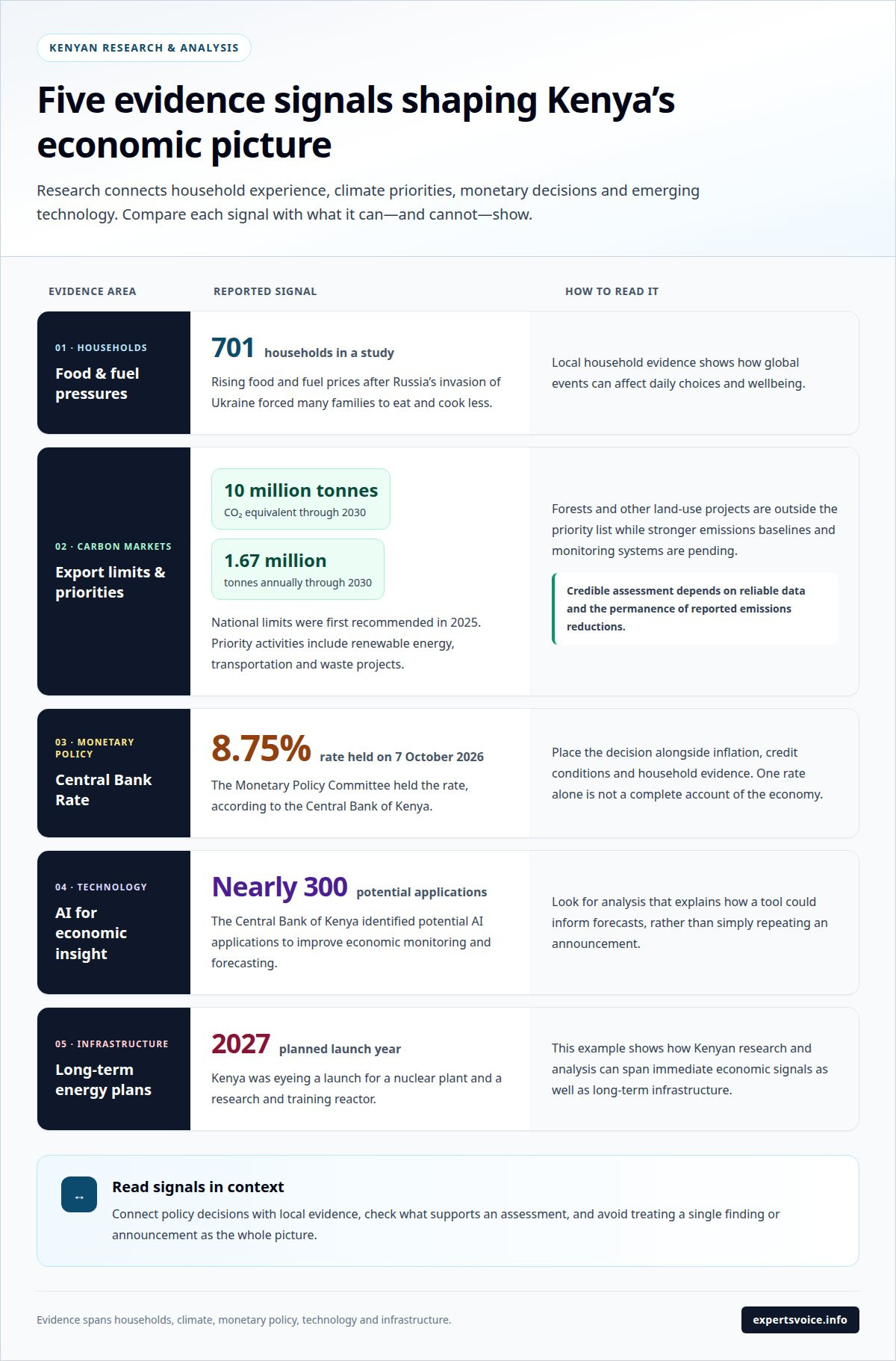
Kenyan research connects national policy debates with evidence from households, markets and public institutions. A study of 701 households found that rising food and fuel prices after Russia’s invasion of Ukraine forced many families to eat and cook less. The finding links global events to daily decisions and shows why locally grounded evidence matters when assessing economic pressure and household wellbeing.
Climate research also informs Kenya’s position in international carbon markets. Kenya has limited carbon credit exports to 10 million tonnes of carbon dioxide equivalent through 2030, equivalent to 1.67 million tonnes annually through 2030. The national limits were first recommended in 2025. Priority activities include renewable energy, transportation and waste projects.
Forests and other land-use projects remain outside that priority list while stronger emissions baselines and monitoring systems are pending. These systems matter because credible assessments depend on reliable data and the permanence of reported emissions reductions. For analysts, this distinction helps explain which projects currently align with Kenya’s stated export priorities and what evidence supports their assessment.
Monetary policy provides another clear example of research shaping economic interpretation. The Central Bank Rate was 8.75% after the Monetary Policy Committee held it on 7 October 2026, according to the Central Bank of Kenya. Readers can place that decision beside inflation, credit conditions and household evidence, rather than treating one rate as a complete account of the economy.
Technology analysis adds a further dimension. The Central Bank of Kenya identified nearly 300 potential AI applications to improve economic monitoring and forecasting. Kenya was also eyeing a 2027 launch for a nuclear plant and a research and training reactor. Together, these examples show how research spans immediate economic signals and long-term infrastructure. To explore how Kenyan perspectives connect policy with evidence, consider curated Kenyan analysis.
Who are the leading experts and authors writing about Kenya?
Expertise on Kenya spans research, public policy, economics and governance. Readers should distinguish an author’s subject knowledge from the public figures discussed in their work. President William Ruto, for example, may feature in political analysis, but that does not make him its author. Strong analysis identifies its evidence, explains its scope and separates documented events from interpretation.
For economic questions, look for authors who examine monetary policy, household conditions and market signals. The Central Bank of Kenya identified nearly 300 potential AI applications for economic monitoring and forecasting. That example gives readers a useful test: does an analysis explain how a tool could inform forecasts, or does it simply repeat an announcement? Evidence and method help establish the author’s contribution.
Governance writing calls for a different lens. Energy Cabinet Secretary Opiyo Wandayi appeared before the Senate on May 6, 2026, while Treasury Cabinet Secretary John Mbadi was part of political coverage surrounding an ODM retreat in Mombasa on May 4. These figures are subjects in public affairs reporting, not automatically the analysts behind it. Evaluate the author’s interpretation separately from the event.
When comparing Kenyan authors, use a practical sequence:
- Identify the field. Establish whether the piece addresses monetary policy, technology, climate or governance.
- Locate the evidence. Check whether its claims rely on research, institutional decisions or clearly described events.
- Assess the reasoning. Separate the reported facts from the author’s explanation and conclusions.
- Consider local relevance. Ask whether the analysis connects national decisions with Kenyan households, institutions or markets.
This approach helps readers identify relevant expertise without relying on reputation alone. It also clarifies why a researcher’s account of economic indicators differs from a political correspondent’s interpretation of Senate proceedings. When assessing Kenya expert articles, consider whether the author’s method and subject fit your question.
What do experts say about Kenya’s politics, laws, and governance?
Political analysis in Kenya often examines shifting alliances, public accountability and institutional decisions. Five ministers joined President William Ruto’s government in 2024 amid a Gen Z uprising. They had opposed the government after Kenya’s 2022 elections before joining it. This sequence invites analysis of coalition-building, public pressure and how political positions change over time. Strong commentary distinguishes those documented developments from an author’s interpretation of their causes.
Party processes provide another measure of governance. UDA gave members 24 hours to challenge ward election results in Tharaka Nithi and Bomet counties. The short challenge window directs attention to how parties manage internal disputes and communicate decisions. Readers can assess what a report says about the process, which actors it names, and whether it separates party rules from wider electoral institutions.
Legal analysis benefits from tracing a dispute through its duration and institutional setting. A court dispute over multibillion-shilling compensation sought from the National Social Security Fund had continued for 15 years. That timeline highlights the value of examining procedural history alongside the parties’ claims. Commentary should clarify what is being sought, which institution is involved, and how the dispute has progressed.
For a careful reading, separate each account into three parts: the reported event, the relevant institution and the author’s conclusion. For example, UDA’s challenge period concerns party election results, while the NSSF matter concerns a court dispute. Treating these as distinct cases avoids collapsing party procedure and litigation into a general claim about governance. It also helps readers see where evidence supports an interpretation.
Kenya expert articles can support this assessment when they distinguish evidence from opinion and explain institutional context. Explore expert analysis of Kenyan governance to follow these debates through focused perspectives.
Kenya has a population of about 58 million people, placing governance debates against a broad national backdrop. The Kenyan government expected to award the Mrima Hill mineral project deal within three weeks. Such reporting can help readers assess how public decisions, resource projects and institutional accountability intersect, while keeping expectations distinct from confirmed outcomes.
Experts Voice: Experts Voice Digital Media & Knowledge Platform
Experts Voice’s Digital Media & Knowledge Platform offers informed perspectives on issues shaping Kenya. After reviewing policy developments, research and governance debates, readers can continue exploring relevant expert knowledge and connect different topics to their practical context.
The platform is a useful next step when a strategy discussion calls for a clearer understanding of Kenya’s economic, technological or institutional environment. Readers can explore perspectives that support further inquiry while distinguishing analysis from official decisions and documented events. This complements evidence-led reading without treating any single viewpoint as a complete account.
To continue exploring expert perspectives, visit expertsvoice.info.
Carry Kenyan insight into your next decision
Strategic decisions benefit from analysis that connects national developments with the conditions shaping an organisation, sector or community. Use Kenya expert articles as a starting point, then identify which perspectives address your question, what evidence informs them and where further context is needed. This discipline helps turn reading into a considered basis for discussion and planning.
Keep your inquiry focused: define the decision ahead, distinguish evidence from interpretation, and note how institutional or economic changes could affect your priorities. Revisit relevant analysis as circumstances evolve instead of treating a single article as a substitute for ongoing judgement. A clear question makes it easier to find insight relevant to your next step.
For a continuing perspective on expert knowledge, contact Experts Voice for expert insight. Thoughtful inquiry can help you approach Kenya’s changing landscape with greater clarity and purpose.
Frequently Asked Questions
What do expert articles about Kenya refer to?
Kenya expert articles are written analyses that explain issues affecting the country through informed, subject-focused perspectives. They may interpret policy, economic conditions, technology or governance for readers seeking context beyond a headline. A useful article identifies its subject and evidence, distinguishes reporting from opinion, and explains why its analysis matters to Kenyan institutions, businesses or communities.
Which topics do these articles cover?
Topics may include Kenya’s economy, public policy, governance, cybersecurity, innovation, agriculture, agribusiness and entrepreneurship. The most useful subject depends on the reader’s decision: an enterprise assessing digital risks may need cybersecurity analysis, while a researcher studying food systems may seek agricultural perspectives. Experts Voice’s digital media and knowledge platform brings together content across several of these fields.
What are current expert analyses of Kenya’s economy and business environment?
Current analysis examines how monetary policy, inflation, access to finance, technology and sector conditions affect decisions. For practical insight, compare commentary on national economic signals with evidence relevant to your sector or organisation. A business assessing investment, for example, can distinguish economy-wide trends from operating constraints such as customer demand, infrastructure needs and regulatory exposure.
How can I access or publish expert articles about Kenya?
Explore Kenya expert articles on the Experts Voice Digital Media & Knowledge Platform, then narrow your reading by topic and intended use. To prepare a contribution, define its central question, identify the audience, and organise claims around evidence and relevant Kenyan context. A concise outline and clear author expertise help frame a proposed article for consideration by Experts Voice.