
Reliable business information in Kenya begins with official records, including business registration information from the Business Registration Service, while investment conditions should be assessed through specific indicators rather than a single measure. In the 2026 Index of Economic Freedom, Kenya ranked 116th, with a score of 55.5.
Sound decisions depend on distinguishing official records from broader analysis of the business environment. This guide explains where to find reliable business information in Kenya, which business data to examine, and how to interpret investment rankings in context. It also clarifies how registration records, market research, and comparative indexes answer different questions, helping you build a balanced view of a company, sector, or investment opportunity. The practical starting point is to identify the question you need answered, then choose the institution or measure that can answer it. The sections below take you from formal records to wider market context.
Key Takeaways
- Match each business question to the relevant official Kenyan institution, distinguishing registration records from wider economic and sector information.
- Read investment rankings by their scope and indicators, rather than treating a single score as a complete measure of business conditions.
- Use business categories to narrow searches, then compare available records and descriptions to establish which entities fit your needs.
- Combine official information with structured market discovery to develop a more practical view of customers, sectors, and commercial opportunities.
Business climate and investment rankings
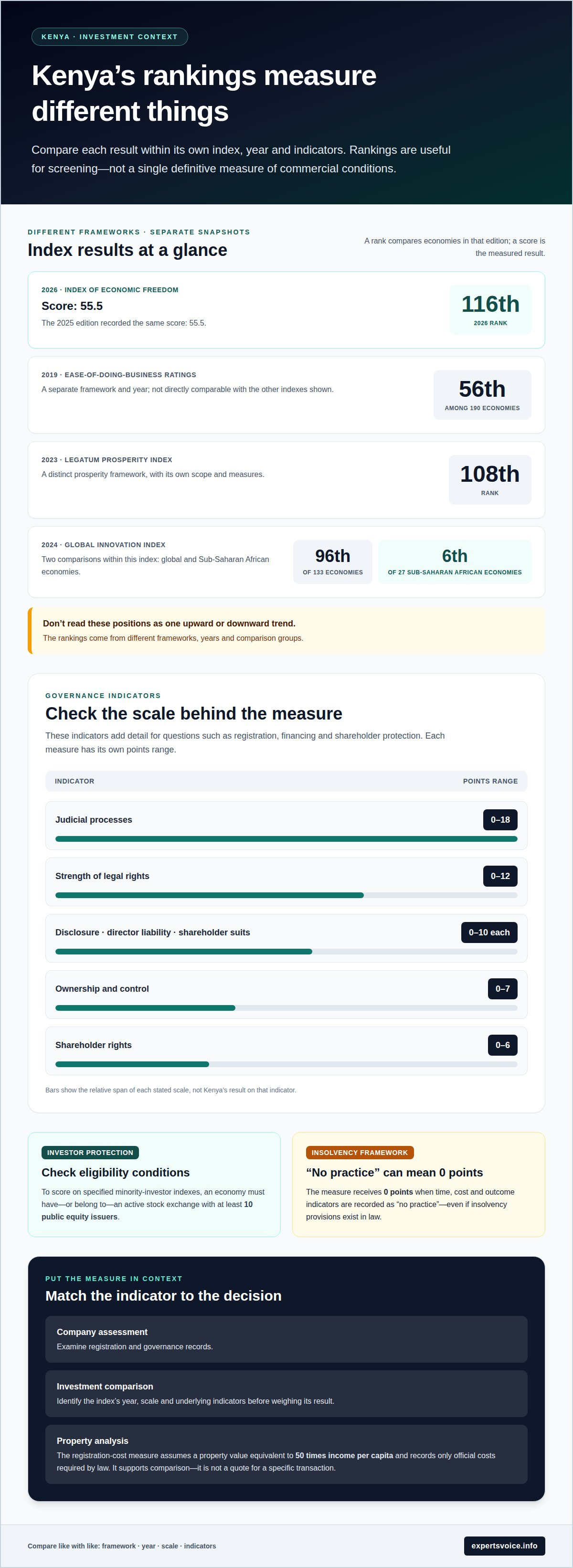
Kenya’s investment rankings provide distinct perspectives, not one definitive measure of commercial conditions. The 2026 Index of Economic Freedom ranked Kenya 116th, with a score of 55.5. The 2025 edition recorded the same score, 55.5. Investors should distinguish the score from the ranking: one describes a measured result, while the other compares economies in that edition.
Historical comparisons require attention to the index and year. Kenya ranked 56th among 190 economies in the 2019 ease-of-doing-business ratings. It ranked 108th in the 2023 Legatum Prosperity Index. The 2024 Global Innovation Index placed Kenya 96th among 133 economies, and sixth among 27 Sub-Saharan African economies. These positions concern different frameworks, so they should not be read as a single upward or downward trend.
Governance indicators add detail relevant to registration, financing, and shareholder protection. Measures include legal rights, disclosure, director liability, shareholder suits, judicial processes, and insolvency frameworks. Their scales differ: the strength of legal rights ranges from 0 to 12 points, while judicial processes range from 0 to 18. Disclosure, director liability, and shareholder suits each use a 0-to-10 scale.
Investor-protection measures also have defined boundaries. Shareholder rights range from 0 to 6 points, while ownership and control range from 0 to 7. An economy must have, or belong to, an active stock exchange with at least 10 public equity issuers to score on specified minority-investor indexes. Kenya’s insolvency framework measure receives 0 points when time, cost, and outcome indicators are recorded as “no practice,” even if insolvency provisions exist in law.
Use rankings as screening tools, then connect them to the decision being made. For a company assessment, examine registration and governance records. For an investment comparison, identify the index’s year, scale, and underlying indicators before weighing its result. For property analysis, note that the registration-cost measure assumes a property value equivalent to 50 times income per capita and records only official costs required by law. This makes the measure comparable, not a quote for a specific transaction.
Kenyan government agencies and official information sources
Kenyan government records help distinguish formal business registration from tax documentation and financial evidence. The Business Registration Service (BRS) is the starting point for company searches.
Company Registration Verification
To verify registration, search the BRS online service using the company’s name or registration details, then compare the result with documents supplied by the business. BRS says name reservation and business registration are combined in one online application process. A company name search costs approximately KSh 150; this differs from a registration fee.
Use the BRS online service to search by business name or identifying details, then review the information available for that entity. Compare the returned record with the name on contracts and registration documents. This helps establish whether the business appears in official registration records, but it does not verify every claim about its operations.
Financial Statements and Credit Reports
Start with financial statements published by the business or supplied by its representatives. Check the entity name and reporting period, and confirm that the figures cover the company you are assessing. For credit reports, use a formal credit-reporting channel and match the report to the correct legal entity. The records serve different purposes: financial statements describe reported performance, while credit reports concern credit history.
For tax checks, use Kenya Revenue Authority’s official services to validate the supplied KRA PIN and review tax-compliance documentation. Match the PIN holder’s name with the BRS record, since similar trading names can belong to different entities. Check registration and tax status separately.
To examine a company’s physical address, directors, and ownership, compare available BRS information with its own documents and correspondence details. Companies are required to disclose beneficial owners. If names, addresses, or ownership details do not match, note the discrepancy and establish which information is current before relying on it.
Unverified details can lead to mistaken counterparties, unreliable credit decisions, or payments directed to the wrong business. The BRS is located at 17th Floor, 316 UpperHill Chambers, 2nd Ngong Avenue, Nairobi, and its published telephone number is +254 11 112 7000. The service was established under the Business Registration Service Act, 2015. These official details can help distinguish the Kenyan registry from unrelated African listings. For broader commercial context, explore Kenya business insights.
Business categories and search
Business categories help organize searches by activity, customer, or market. A search for agricultural suppliers, for example, differs from one for cybersecurity firms or retail distributors. Begin with the sector, then narrow by product, customer group, or location. This gives reliable business information in Kenya a practical starting point: define the market before comparing individual businesses.
Choose search terms that reflect the decision you need to make. A startup looking for distribution partners might combine its product category with a county or customer segment. A researcher studying food processing could group businesses by products and target markets. Record the terms used so later comparisons apply the same criteria instead of shifting definitions.
Next, decide what evidence can answer your market question. Customer surveys gather structured feedback on needs, preferences, satisfaction, demand, pricing, and buying behaviour. Interviews and focus groups explore motivations, barriers, experiences, and unmet needs in greater depth. Choose the method that fits the decision: surveys help compare responses, while interviews can explain why customers prefer one option.
Competitor mapping turns search results into a practical comparison. A matrix can organize firms by pricing, products, positioning, strengths, and gaps, with channels or service quality added where relevant. Then use SWOT analysis to classify strengths, weaknesses, opportunities, and threats. These tools help distinguish direct competitors serving the same customers from businesses in a broad category that meet different needs.
Keep a clear record of your research. Note each category, search term, source, and item of evidence, and separate verified records from descriptive claims. Excel, SPSS, and survey tools can support data cleaning, descriptive statistics, charts, and reporting. A market research report can bring findings, interpretation, and recommendations together. This organized process makes reliable business information in Kenya more useful for decisions about customer segments, distribution, and market positioning.
Business discovery in Kenya
Business discovery helps identify potential suppliers, customers, partners, and competitors across Kenyan markets. Combine sector terms with a county, product, or customer group to make searches more relevant.
Finding Businesses in Kenya
Begin with the activity and location, such as “food processing in Nakuru” or “logistics in Mombasa.” Then search the business name alongside its product or service to distinguish similarly named enterprises. For a startup assessing suppliers, this approach can identify candidate businesses and help structure initial market research.
Use search results to build a shortlist, not to make a final decision. Record each listing’s business name, stated location, activity, and contact details. Compare these details with available registration records and documents before relying on them. When legal or regulatory issues arise, lawyers and other advisers can assess them. The search helps identify which businesses warrant closer review.
Assessing Directory and Listing Reliability
Kenyan business directories and online company listings are useful discovery tools, but entries may be incomplete, outdated, or self-submitted. Treat an address or service description as a lead, not proof of registration, ownership, or current operations. A listing alone does not establish that a business remains active.
Compare an entry against official records and the business’s own documents. Look for consistency in its legal name, location, activities, and contact information. If a directory describes a Nairobi firm as an established supplier, for example, verify the entity separately before making a financial or contractual decision.
For a structured review, group candidates by sector and location, then note what evidence supports each entry. Separate confirmed registration details from directory descriptions and claims made by the business. This distinction helps prevent an online profile from being mistaken for a complete due-diligence record.
Use discovery findings to guide further market analysis, including customer needs, distribution channels, affordability, and competitive positioning. Explore business information resources to continue examining Kenya’s commercial landscape.
Experts Voice: Experts Voice Digital Media & Knowledge Platform
Experts Voice offers the Experts Voice Digital Media & Knowledge Platform as a next step for readers seeking broader context after reviewing official records and investment indicators. It provides a knowledge-sharing environment for continued engagement with business questions, complementing rather than replacing government documents or registry checks. Turn to the platform when you want to extend your understanding beyond a single company search and consider wider perspectives relevant to Kenya’s commercial environment. Official sources remain the basis for verifying registration, tax documentation, and other formal records; wider knowledge resources can help frame the questions those records raise. Visit expertsvoice.info to explore Experts Voice.
Put Your Business Research to Work
Connect your research to a specific decision. Before approaching a supplier, assessing an opportunity, or planning a market entry, define what evidence matters and how it will guide your next step. Reliable business information in Kenya is most useful when it helps you frame a practical question, distinguish formal records from market context, and identify what you still need to understand.
The Experts Voice Digital Media & Knowledge Platform offers broader knowledge alongside official information. Its coverage of business, agriculture, technology, and other topics can help you understand Kenya’s business environment, while government records remain essential for verifying formal details. Start with a clear research question, whether you are studying a sector or developing your understanding of business conditions.
To continue the discussion, contact Experts Voice. A considered next step can turn your research into more focused decisions.
Frequently Asked Questions
What are reliable sources for business information in Kenya?
Use the institution responsible for the specific record: the Business Registration Service for company registration details and the Kenya Revenue Authority for tax-related documents. For a sector-specific claim, consult the relevant regulator or government department. Compare records using the business’s legal name rather than relying on a trading name alone. Statements and documents from the business can add context, but they serve a different purpose from official records.
How can I check business permits and licenses in Kenya?
Identify the business activity and where it operates, because the relevant permit issuer depends on both. Review the permit for the holder’s legal name, covered activity, issuing authority, validity details, and stated conditions. Then use the issuer’s official verification channel or contact point to confirm the document’s status. A registration record alone does not establish that a business holds every permit its activities may require.